history
Porsche 917: the story of the car that conquered Le Mans
The legend of the Porsche 917: from its dangerous debut to back-to-back Le Mans wins. History, engine and the Steve McQueen myth.
11 min read
In 1970 a German car painted fluorescent orange crossed the finish line at Le Mans. It was the Porsche 917, the car that forever changed endurance racing. Its story mixes extreme engineering, tragedy, victories and the legend of Steve McQueen at the Circuit de la Sarthe.
The origin of the 917
It all started with a rule change. In 1968 the FIA allowed 5-liter engines for cars homologated with 25 units built. Porsche saw the opportunity to win Le Mans for the first time in its 20 years of trying.
Project 917 began in July 1968 under Ferdinand Piëch. In just 10 months, Porsche built the 25 required units. An absolute development record.
Key fact: Porsche lined up all 25 cars in the Zuffenhausen parking lot for FIA inspectors to count. Historic.
A 12-cylinder boxer engine
The heart of the 917 was an air-cooled 4.5-liter flat-12 engine (later 4.9 and 5.0). Engineering madness.
| Version | Engine | Power | Year |
|---|---|---|---|
| 917 K | 4.5L Flat-12 | 580 HP | 1969-1970 |
| 917 K (5.0) | 4.9L Flat-12 | 600 HP | 1970-1971 |
| 917/10 TC | 5.0L Turbo | 850 HP | 1972 |
| 917/30 | 5.4L Twin-Turbo | 1,100 HP | 1973 |
Can you imagine 1,100 HP in a 1970s chassis? Mark Donohue's 917/30 is the most powerful competition car of its era.
A dangerous debut
The first 917s were unstable at high speed. At Le Mans 1969 Briton John Woolfe died on the first lap. The original version was practically impossible to drive.
John Wyer and Brian Redman redesigned the car's tail. The "Kurzheck" (short tail) body was born, transforming the 917 into a drivable car. The fix was as simple as lowering the tail angle to generate downforce.
The two Le Mans wins
In 1970 Porsche won Le Mans for the first time in its history. It was with a Porsche Salzburg 917 K, driven by Hans Herrmann and Richard Attwood. They completed 343 laps in extreme rain conditions.
- 1970: Herrmann/Attwood victory (red and white 917 K)
- 1971: Marko/Van Lennep victory (Martini blue 917 K)
- 1971: distance record of 5,335 km in 24 hours (unbeaten for 39 years)
Key fact: the 1971 distance record wasn't broken until 2010 by Audi. It defined the 917 forever.
The Steve McQueen myth and the Le Mans film
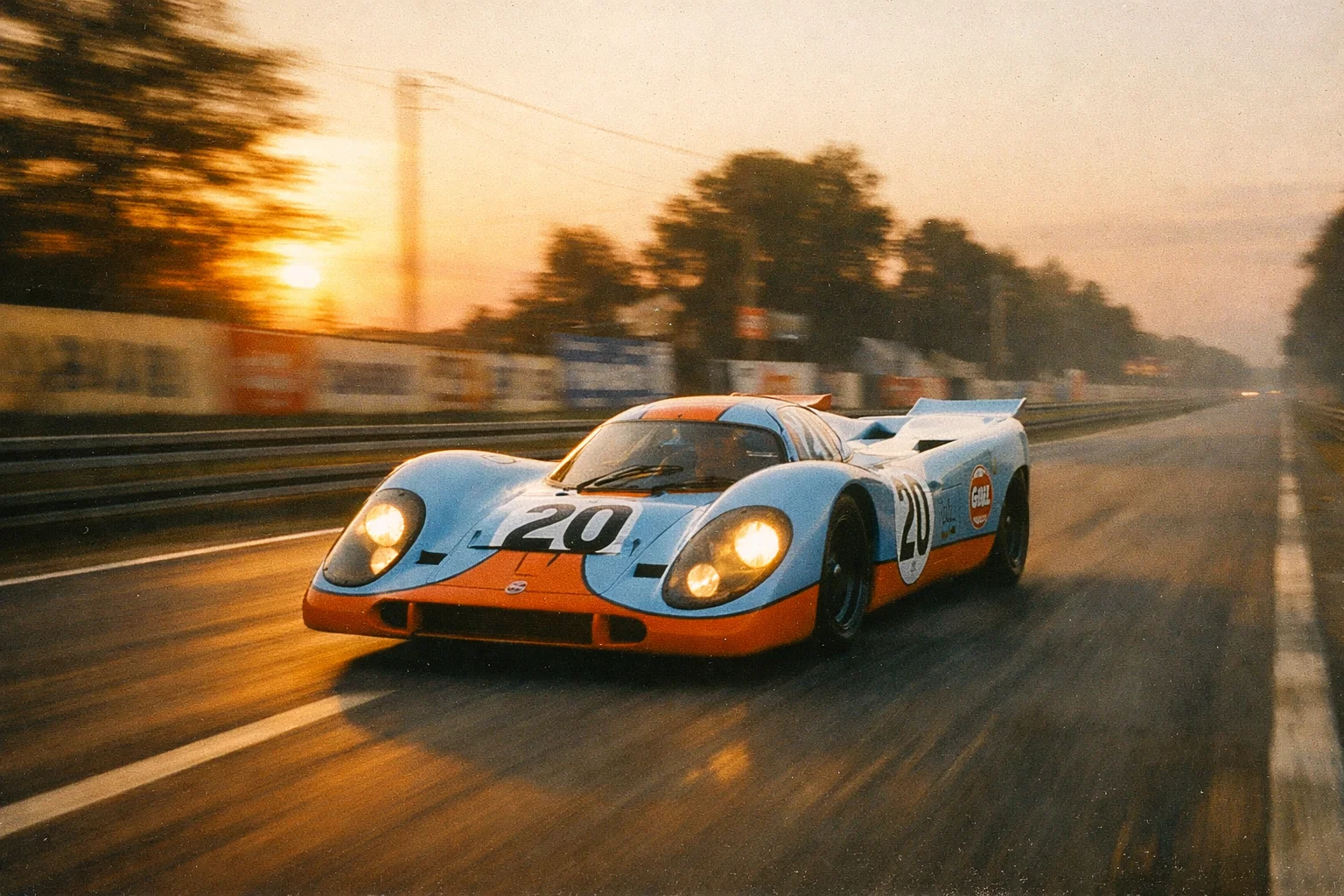
In 1970 Steve McQueen shot the film "Le Mans" with cameras mounted on a 917 K. The Gulf Oil blue and orange of the film became the most iconic color scheme in motorsport.
McQueen tried to race Le Mans that year, but his insurance prohibited it. In the film, his character Michael Delaney drives a 917 K with number 20. That exact car sold in 2017 for $14 million.
Dominance in Can-Am
When Le Mans rules changed in 1972 eliminating 5-liters, Porsche took the 917 to American Can-Am. Here the ultimate monster was born: the 917/30 with 1,100 HP.
Mark Donohue won 6 of 8 races in the 1973 season. The 917/30 was so dominant that SCCA changed rules to limit fuel consumption and take it out.
Frequently asked questions
How many Porsche 917s were built in total?
Porsche built 65 units of the 917 across all versions: 25 initial homologation plus K, LH, PA, 10 and 30 evolutions.
How much does a Porsche 917 cost today?
A 917 K with race history runs €20-30 million at auction. The McQueen film car sold for $14 million in 2017.
Where can I see a Porsche 917 in Spain?
The Porsche Museum in Stuttgart has several. In Spain there's only one in a private collection. At our Gredos Garage museum we display classics and restomods on rotation.
Who drove the winning 917 K at Le Mans 1970?
Hans Herrmann (Germany) and Richard Attwood (UK). Herrmann retired from motorsport after that win, keeping a promise to his mother.
The Porsche 917 was not just a race car. It was the turning point that showed what German engineering could do without limits. If you love the cars that made history, come by our museum in La Adrada and let's talk motorsport like in the old days.