history
Porsche 911: 60 years of evolution of an icon
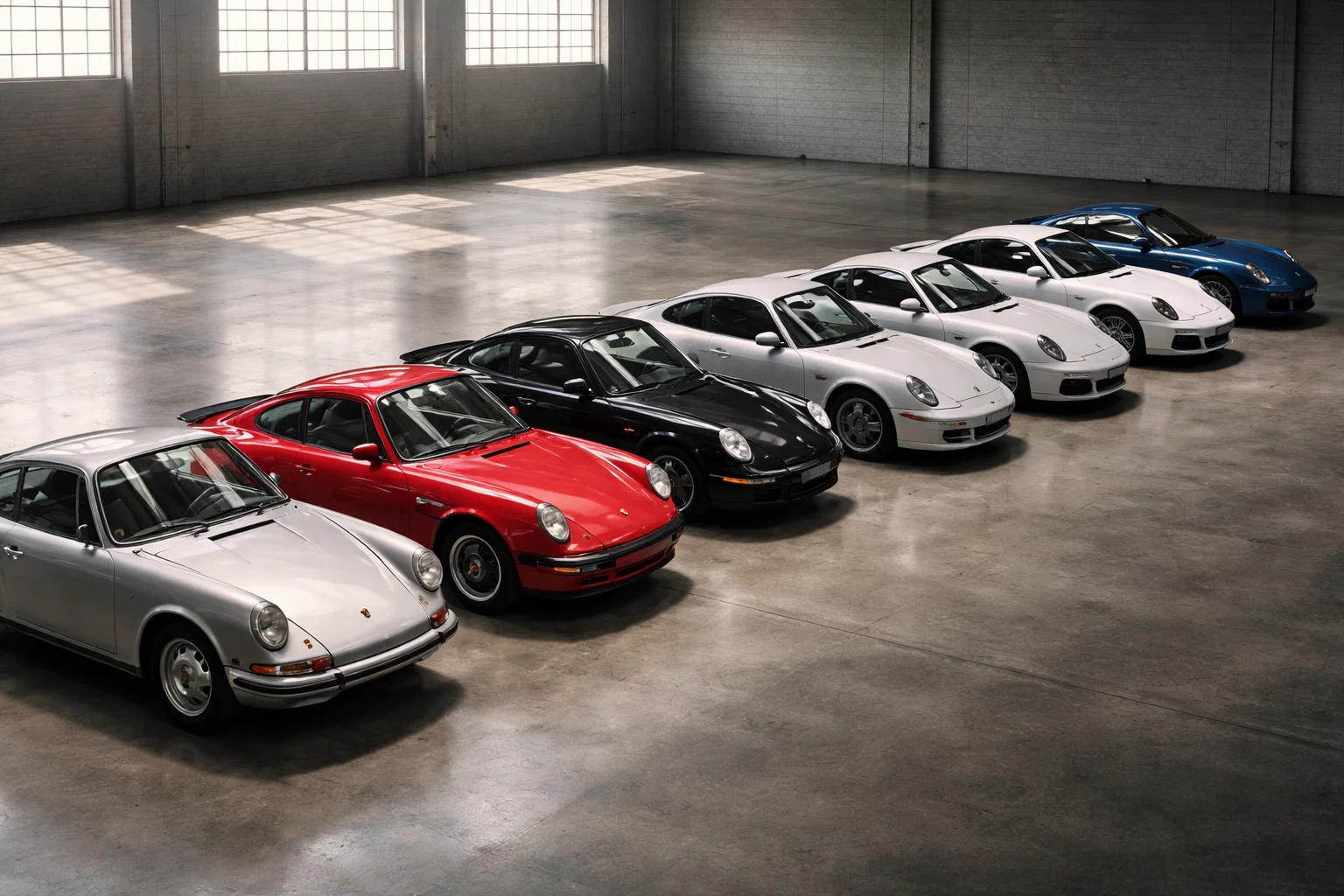
Porsche 911 evolution over 60 years: from the 1963 901 to todays 992. All generations, engines, figures and market records.
11 min read
Talking about Porsche 911 evolution means talking about the history of the modern sports car. 60 years. 8 generations. Over 1.2 million units built. And the same engine sitting behind the rear axle, defying all engineering logic. The 911 is the car that was supposed to disappear for decades and never does.
It debuted at the Frankfurt Motor Show in September 1963 as the 901. Peugeot claimed the zero-middle numbers as theirs. Porsche swapped the 0 for a 1 and the 911 was born. It carried a 2.0-litre air-cooled flat-six with 130 HP. Cost 21,900 Deutsche Marks.
This article reviews the 8 generations of 911: from the original to the current 992 GT3 RS. Engines, differences, market prices and why classic 911s are worth more than ever.
Table of contents
- The origin: from 356 to 901 (1963)
- Classic 911s: 901, G-Series and 964 (1963-1994)
- The modern era: 993, 996, 997 (1994-2012)
- 991 and 992: the digital age (2012-today)
- Current market and records
- Frequently asked questions
The origin: from 356 to 901 (1963)
The Porsche 901 was born to replace the 356. Ferry Porsche wanted something bigger, faster, with real 4 seats. His son Ferdinand Alexander "Butzi" Porsche handled the design. He was 27. He drew the silhouette that still defines the car six decades later.
The 901 debuted in Frankfurt in September 1963. It was produced under that name until 1964. Only 82 units carry the 901 designation. Peugeot then claimed naming rights in France and Porsche rebranded it 911 in October 1964.
- Launch: Frankfurt Motor Show, September 1963
- Engine: air-cooled 2.0 flat-six, 130 HP
- Launch price: 21,900 Deutsche Marks (about 5,600 USD of 1964)
- Top speed: 210 km/h
- Designer: Ferdinand Alexander Porsche (Butzi)
Key fact: In 2014 a 1964 901 found in a German barn was restored and now sits at the Porsche Museum in Stuttgart. One of the 82 original units.
Why rear engine? Because Porsche came from the 356, which came from the Volkswagen Beetle. It was the DNA. Placing the engine behind the axle was technical heresy but it worked. Each generation refined that impossible architecture.
Classic 911s: 901, G-Series and 964 (1963-1994)
The classic Porsche 911 era covers three generations: the original (1963-1973), G-Series (1973-1989) and 964 (1989-1994). These are the air-cooled 911s that investors worldwide collect today.
| Generation | Years | Engine | Max power | Icon |
|---|---|---|---|---|
| Original (901) | 1963-1973 | 2.0-2.7 flat-six | 210 HP | 2.7 Carrera RS |
| G-Series | 1973-1989 | 2.7-3.2 flat-six | 330 HP | 930 Turbo |
| 964 | 1989-1994 | 3.3-3.6 flat-six | 360 HP | 964 Turbo 3.6 |
The Carrera RS 2.7 of 1973 is the Holy Grail. 1,580 units. 210 HP, 1,075 kg, 245 km/h. Ducktail spoiler. Today an RS 2.7 Lightweight exceeds 1.2 million euros at auction.
The 930 Turbo of 1975 changed the rules. First turbocharged 911. 260 HP initially, later 300 HP. Whale tail wing. Brutal, unpredictable, devilishly fast. It earned the "widowmaker" nickname for its monstrous turbo lag.
Auction record: A 1973 Carrera RS 2.7 Lightweight sold for 1.43 million euros at RM Sotheby's Monaco 2022. The most expensive production classic 911 recorded.
The 964 of 1989 was the first 911 with all-wheel drive (Carrera 4), ABS, power steering and airbag. Kept the classic silhouette but modernised everything else. The 964 RS of 1992 is absolute cult material today.
- Original 901/911: 1963-1973, 81,100 total units
- G-Series: 1973-1989, 198,496 units
- 964: 1989-1994, 63,762 units
The modern era: 993, 996, 997 (1994-2012)
The 993 was the last air-cooled 911. Built 1994-1998. Only 68,881 units. Purists consider it the perfect 911: modern enough to drive daily, analogue enough to feel it. A 993 Carrera 2 today sits around 90,000 euros.
The 996 broke everything in 1997. Water cooling. "Fried egg" headlamps. Architecture shared with the Boxster. Purists despised it. The market punished it for 20 years. Now it recovers as the cheapest entry 911.
| Generation | Years | Cooling | Units | Current Carrera price |
|---|---|---|---|---|
| 993 | 1994-1998 | Air | 68,881 | 85,000-130,000 |
| 996 | 1997-2005 | Water | 175,262 | 25,000-45,000 |
| 997.1 | 2004-2008 | Water | approx. 105,000 | 40,000-60,000 |
| 997.2 | 2008-2012 | Water (DFI) | approx. 108,000 | 55,000-85,000 |
The 997 fixed the 996 aesthetic errors. Round headlamps again. Interior quality restored. The 997.2 (2008-2012) added DFI direct injection and PDK dual-clutch. It is today the recommended gateway to the modern 911.
Expert tip: Want a modern 911 with classic soul? Buy a 997.2 Carrera S manual. 385 HP, reliable engine without IMS bearing issue, optional PDK. Best quality-price-fun balance.
And the famous IMS issue on 996 and 997.1? It affected the intermediate shaft bearing. Could destroy the engine without warning. The 997.2 eliminated the IMS bearing entirely. That is why it costs more.
991 and 992: the digital age (2012-today)
911 evolution entered the digital era with the 991 in 2012. Wider body, 100 mm longer wheelbase, weight held to 1,380 kg. All-new suspension. Naturally aspirated until 2015, turbo from 2016 (991.2) across the Carrera range.
The 992 arrived in 2019. The current 911. Even wider body, mixed aluminium and high-strength steel. 3.0 biturbo engine with 385-480 HP in the Carrera range. GT3 with 510 HP naturally aspirated to 9,000 rpm. And the 2022 992 GT3 RS with 525 HP and LMP2-level aero.
- 991.1 (2012-2015): last naturally aspirated Carreras
- 991.2 (2016-2019): turbo across the entire Carrera range
- 992.1 (2019-2024): current generation, 3.0 biturbo
- 992.2 (2024-): T-Hybrid in Carrera GTS
The 2023 992 GT3 RS is the fastest 911 at the Nürburgring Nordschleife. 6 minutes 49.328 seconds. Generates 860 kg of downforce at 285 km/h. Practically an LMP2 with plates.
Track record: 992 GT3 RS, Nurburgring Nordschleife, 6:49.328 (October 2022). 10.6 seconds faster than the 991 GT3 RS.
Porsche announced in 2024 the first hybrid 911: the Carrera GTS T-Hybrid. 400V electrical system, 3.6 biturbo engine. 541 combined HP. Not plug-in. A mild-hybrid to cut emissions while keeping character.
Current market and records
The classic Porsche 911 market grew 400% between 2010 and 2020. After the 2019 peak it dropped slightly. Today it sits on a stable plateau with strong demand for collector models. Which 911 is climbing most? The 964 and 993.
| Model | 2015 price | 2024 price | Change |
|---|---|---|---|
| 911 2.7 Carrera RS 1973 | 450,000 | 950,000 | +111% |
| 930 Turbo 3.3 1989 | 85,000 | 190,000 | +124% |
| 964 Carrera 2 Tiptronic | 40,000 | 75,000 | +88% |
| 993 Carrera 2 manual | 55,000 | 105,000 | +91% |
| 996 Carrera Tiptronic | 18,000 | 28,000 | +56% |
The absolute 911 record was set by a 1967 911 R at Gooding & Company Monterey 2023: 3.63 million dollars. Only 20 original 911 R units, competition version with 210 HP and 800 kg.
Historic record: Porsche 911 R of 1967, chassis 118992R, sold for 3,630,000 USD at Monterey 2023. Most expensive production 911 ever auctioned.
At our Gredos Garage museum in La Adrada we host classic Porsches from several generations. You can see live how the silhouette evolved from the original 901 to the 964 and 993. The visit is worth it.
Frequently asked questions about the Porsche 911
How many Porsche 911 generations exist?
Eight official generations: 901/Original (1963-73), G-Series (1973-89), 964 (1989-94), 993 (1994-98), 996 (1997-2005), 997 (2004-12), 991 (2012-19) and 992 (2019-present).
Which 911 is best to start collecting?
A 997.2 Carrera S manual 2009-2012. Reasonable price (55,000-80,000), reliable IMS-free engine, analogue drive, upside potential. The market sweet spot.
Why are air-cooled 911s so expensive?
Because they are finite. Not built since 1998. Unique character: sound, response, analogue mechanics. Demand grows while supply is fixed. Basic economics applied to collecting.
What does "matching numbers" mean on a Porsche 911?
It means the engine and gearbox match the original factory numbers. Porsche issues origin certificates for 250 euros. A matching numbers 911 is worth 30% to 50% more.
Can a 911 be used daily?
Yes, from the 993 onwards. The 991 and 992 are perfectly usable daily. The classics (901, G-Series) require constant maintenance and are not ideal for urban traffic.
Conclusion
The Porsche 911 evolution over 60 years is proof that an apparently wrong concept can become an icon. Engine hung behind the rear axle, immutable silhouette, brutal refinement generation after generation.
If you want to see classic Porsches up close, visit us. At the Gredos Garage museum in La Adrada (Avila) we exhibit several generations. One hour from Madrid. Open all year. We are waiting.