history
American muscle cars: history of the golden era (1964-1974)
History of American muscle cars: Pontiac GTO, Dodge Charger, Ford Mustang, Plymouth Hemi Cuda and more. The decade that defined American motoring.
10 min read
American muscle cars were born in 1964 when Pontiac stuffed a 6.4-litre V8 into a compact car and called it GTO. They broke every internal General Motors rule. They sold like crazy. They created a whole category. For 10 years, between 1964 and 1974, Detroit built the most brutal, fun and excessive machines in automotive history.
The formula was simple: big V8 engine, compact sedan chassis, manual transmission and accessible price. No refinement. No disc brakes. No safety. Just horsepower, smoke and noise. The American dream turned into sheet metal and nuts.
This article reviews the muscle cars golden era: key models, mythic engines, production, current auction prices and why they died in 1974, murdered by the oil crisis and environmental laws.
Table of contents
- The birth: Pontiac GTO 1964
- The kings: Mustang, Camaro, Charger, Cuda
- Mythic engines: 426 Hemi, 454 LS6, Boss 429
- The fall: 1971-1974
- Current market and auction records
- Frequently asked questions
The birth: Pontiac GTO 1964
In 1963 John DeLorean worked in the Pontiac division at GM. GM forbade big engines in midsize cars. DeLorean did it anyway. He took the compact Tempest LeMans, dropped in a 389 cubic-inch V8 (6.4L) and offered it as option. The Pontiac GTO was born.
GM Brass found out late. Already in catalogue. Sold 32,450 units in the first year. 75,352 the next. DeLorean avoided firing because the numbers were unbeatable. Pontiac had invented a new category almost by accident.
- Year: 1964
- Engine: V8 389 ci (6.4L) with 3 Tri-Power carburettors, 348 HP
- 0-100 km/h: 6.6 seconds
- 1964 base price: 2,963 USD
- Creator: John DeLorean (yes, the DMC-12 guy)
Key fact: Pontiac copied the GTO name from Ferrari 250 GTO (Gran Turismo Omologato). Enzo Ferrari never sued. He decided the American gave him free publicity in the USA.
Why did it work? Because 1960s young buyers wanted speed at reasonable price. A Corvette cost 4,200 dollars. A GTO offered comparable performance for 3,000. V8 democracy had just been born in Detroit.
The kings: Mustang, Camaro, Charger, Cuda
After the Pontiac GTO, every Detroit brand answered with its own muscle car. Ford launched the Mustang (1964). Chevrolet the Camaro (1967). Dodge the Charger (1966). Plymouth the Barracuda (1964). The horsepower war was declared.
| Model | Brand | Launch | Top engine | Max HP |
|---|---|---|---|---|
| GTO | Pontiac | 1964 | 455 HO | 370 |
| Mustang | Ford | 1964 | Boss 429 | 375 |
| Charger | Dodge | 1966 | 426 Hemi | 425 |
| Camaro | Chevrolet | 1967 | ZL1 427 | 430 |
| Cuda | Plymouth | 1964 | 426 Hemi | 425 |
| Chevelle SS | Chevrolet | 1964 | LS6 454 | 450 |
The Ford Mustang 1964 sold 418,812 units in its first year. Absolute record. Lee Iacocca conceived it as accessible "pony car". Ponies were compact muscle cars with medium-large engines. The Mustang invented the sub-category.
The 1969 Dodge Charger R/T appeared in Bullitt chasing Steve McQueen. Then starred in The Dukes of Hazzard as General Lee. Pop culture and beastly mechanicals. The 1969 Charger with 440 Six Pack delivered 390 HP.
Cinematic icon: The 1968 Dodge Charger R/T 440 (black) is the most famous car in American cinema. Bullitt (1968) made it eternal against McQueen's Highland Green Mustang GT390.
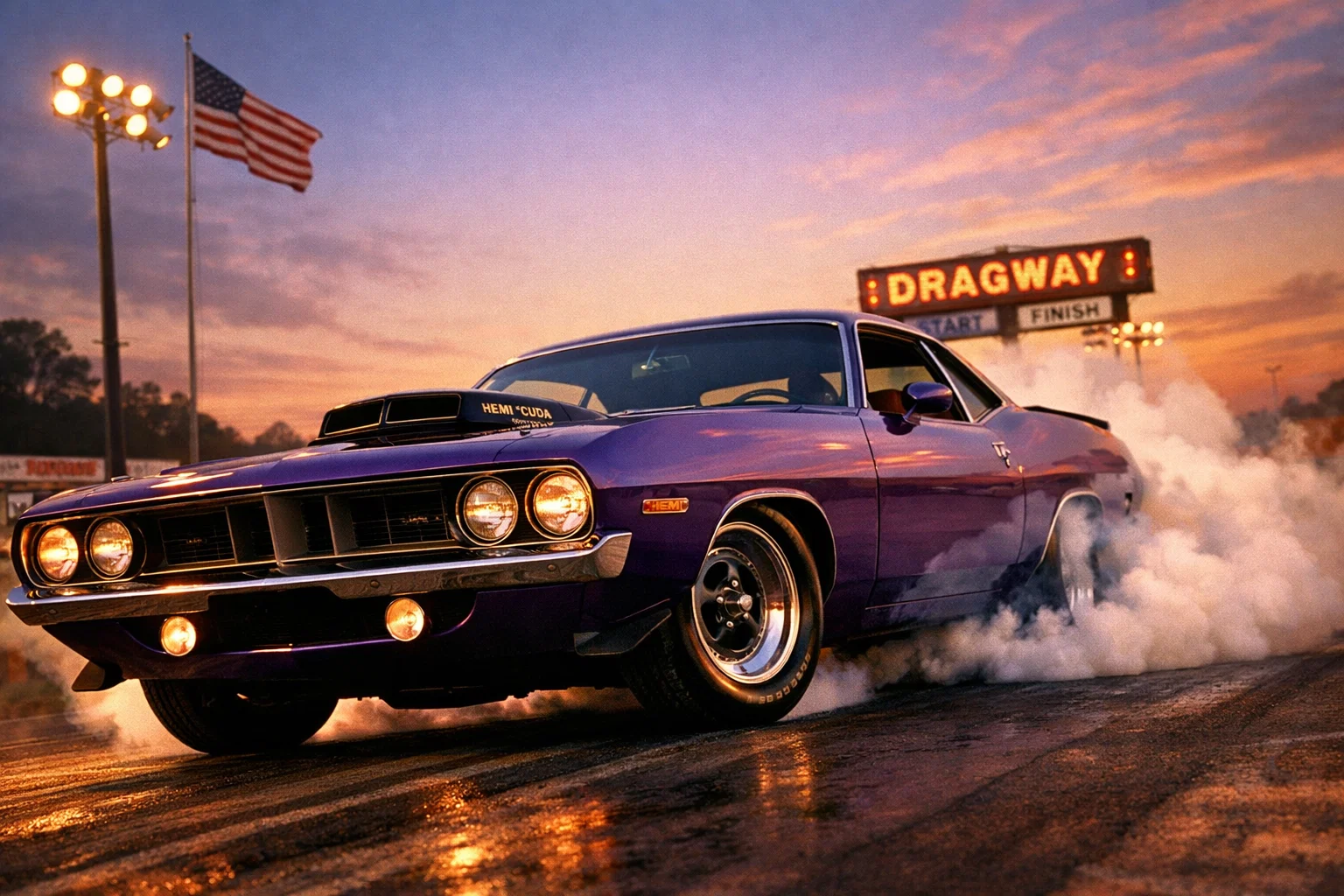
The Plymouth Hemi Cuda of 1970-1971 is today the king of muscle collecting. Only 11 convertible 1971 units with 426 Hemi engine. One sold for 3.5 million dollars at Mecum Auctions 2021. No other muscle car hits those numbers.
Mythic engines: 426 Hemi, 454 LS6, Boss 429
The engines of American muscle cars are their essence. Big V8s with hemispherical or polyspherical heads, Holley or Quadrajet carburettors, visceral exhaust note. Three engines defined the era: Chrysler 426 Hemi, Chevrolet 454 LS6 and Ford Boss 429.
The 426 Hemi "Elephant" from Chrysler debuted in 1964 for NASCAR. Street-homologated from 1966. 425 HP official (over 500 real). Hemi heads, two Carter AFB 4-barrel carbs. Most legendary muscle engine of all time.
- 426 Hemi (Chrysler): 6.9L, 425 HP official, 1964-1971
- 454 LS6 (Chevrolet): 7.4L, 450 HP official, 1970-1971
- Boss 429 (Ford): 7.0L, 375 HP official (500 real), 1969-1970
- 455 Super Duty (Pontiac): 7.5L, 310 net HP, 1973-1974
- 440 Six Pack (Mopar): 7.2L with 3 carbs, 390 HP, 1969-1971
Mechanical trivia: Chrysler declared 425 HP on the 426 Hemi for insurance reasons. Period dynos measured 475-525 real HP. A marketing ruse to cut policies for owners.
The 1970 Chevrolet 454 LS6 was officially the most powerful street muscle ever built: 450 HP. Mounted in the Chevelle SS 454. Ran the quarter mile in 13.12 seconds. Beastly acceleration? Brutal even by today's standards.
These engines drank 25-35 litres per 100 km. In 1970 petrol cost 0.36 dollars per gallon. Nobody cared. Three years later the oil crisis would change everything forever.
The fall: 1971-1974
Three blows killed American muscle cars: the 1970 Clean Air Act, mandatory unleaded petrol (1973) and the oil crisis (October 1973). In 36 months Detroit went from 450 HP beasts to castrated 150 HP cars.
| Model | HP in 1970 | HP in 1974 | Loss |
|---|---|---|---|
| Chevelle SS 454 | 450 | 235 | -215 HP |
| Dodge Challenger R/T | 425 | 245 | -180 HP |
| Pontiac GTO | 370 | 200 | -170 HP |
| Ford Mustang Boss | 375 | 156 | -219 HP |
US insurers also pressed. Muscle car policies tripled between 1970 and 1972. A young buyer paid more insurance than monthly car loan. The equation broke.
Historic milestone: The last golden-era muscle car was the 1974 Pontiac Trans Am Super Duty 455. 290 net HP. Then Pontiac swapped the SD455 for smaller engines. The party was over.
From 1975 muscle cars officially ceased to exist. They would return in the 80s (Mustang GT 5.0, Camaro IROC-Z) and in the 2000s (Challenger SRT, Charger Hellcat), but the original 1964-1974 magic is unrepeatable. That was unique.
Current market and auction records
Muscle cars entered the serious collecting circuit around 2005. Before, they were cheap enthusiast cars. Today they are investment. Mecum and Barrett-Jackson auctions move hundreds of millions annually in muscle cars.
| Model | Concours | Good condition | Project |
|---|---|---|---|
| Hemi Cuda Convertible 1971 | 2,500,000 | 850,000 | 300,000 |
| Boss 429 Mustang 1970 | 380,000 | 230,000 | 110,000 |
| Yenko Camaro 427 1969 | 450,000 | 280,000 | 130,000 |
| Chevelle SS 454 LS6 1970 | 220,000 | 140,000 | 70,000 |
| GTO Judge 1969 Ram Air IV | 180,000 | 110,000 | 55,000 |
| Charger R/T 440 Six Pack 1970 | 160,000 | 95,000 | 42,000 |
The absolute muscle record belongs to a 1971 Plymouth Hemi Cuda Convertible: sold at Mecum Kissimmee 2021 for 4.8 million dollars. Chassis BS27R1B205555. One of only 2 Hemi Cuda Convertibles 1971 with manual gearbox.
Muscle record: 1971 Plymouth Hemi Cuda Convertible, sold for 4,800,000 USD at Mecum Kissimmee 2021. Most expensive muscle car ever auctioned.
In Europe the muscle market is more niche but growing. Spain has an active scene since 2010. European prices are 15-20% higher due to import and restoration costs.
At our Gredos Garage museum in La Adrada we exhibit original American muscle cars from the era. You can see Detroit's raw engineering up close and compare it with contemporary European work. Recommended experience.
Frequently asked questions about muscle cars
What exactly is a muscle car?
A 2-door American car with big V8 engine (5.7L minimum), rear-wheel drive, compact-to-midsize chassis and accessible price. Built mainly between 1964 and 1974 by the Big Three: GM, Ford and Chrysler.
What is the most powerful original muscle car?
The 1970 Chevrolet Chevelle SS 454 LS6 with 450 official HP. Although the 426 Hemi claimed 425 HP, it delivered over 475 in reality. Chrysler underrated figures for insurance reasons.
Why did muscle cars end in 1974?
Combination of 1970 Clean Air Act, unleaded petrol, October 1973 oil crisis and skyrocketing insurance. Detroit castrated engines to comply. Golden era ended.
Are classic muscle cars reliable?
Yes, mechanically. Simple V8s with robust design. Typical problems: chassis rust (especially Mopar), uncalibrated carbs and 60s electrics. Simple but regular maintenance.
Conclusion
Golden-era American muscle cars (1964-1974) represent an unrepeatable philosophy: maximum power at the most accessible price possible. A decade of excess, V8 sound and pop culture that ended in 1974 but lives forever in the automotive global imagination.
If muscle cars move you, visit us. At the Gredos Garage museum in La Adrada (Avila), one hour from Madrid, we exhibit original golden-era examples. You can hear the V8 and understand why they changed history. We are waiting.