history
Mercedes 300SL Gullwing: the icon with gullwing doors
History of the Mercedes 300SL Gullwing, the first production car with direct injection. From Le Mans 1952 to a cult icon worth €1 million.
10 min read
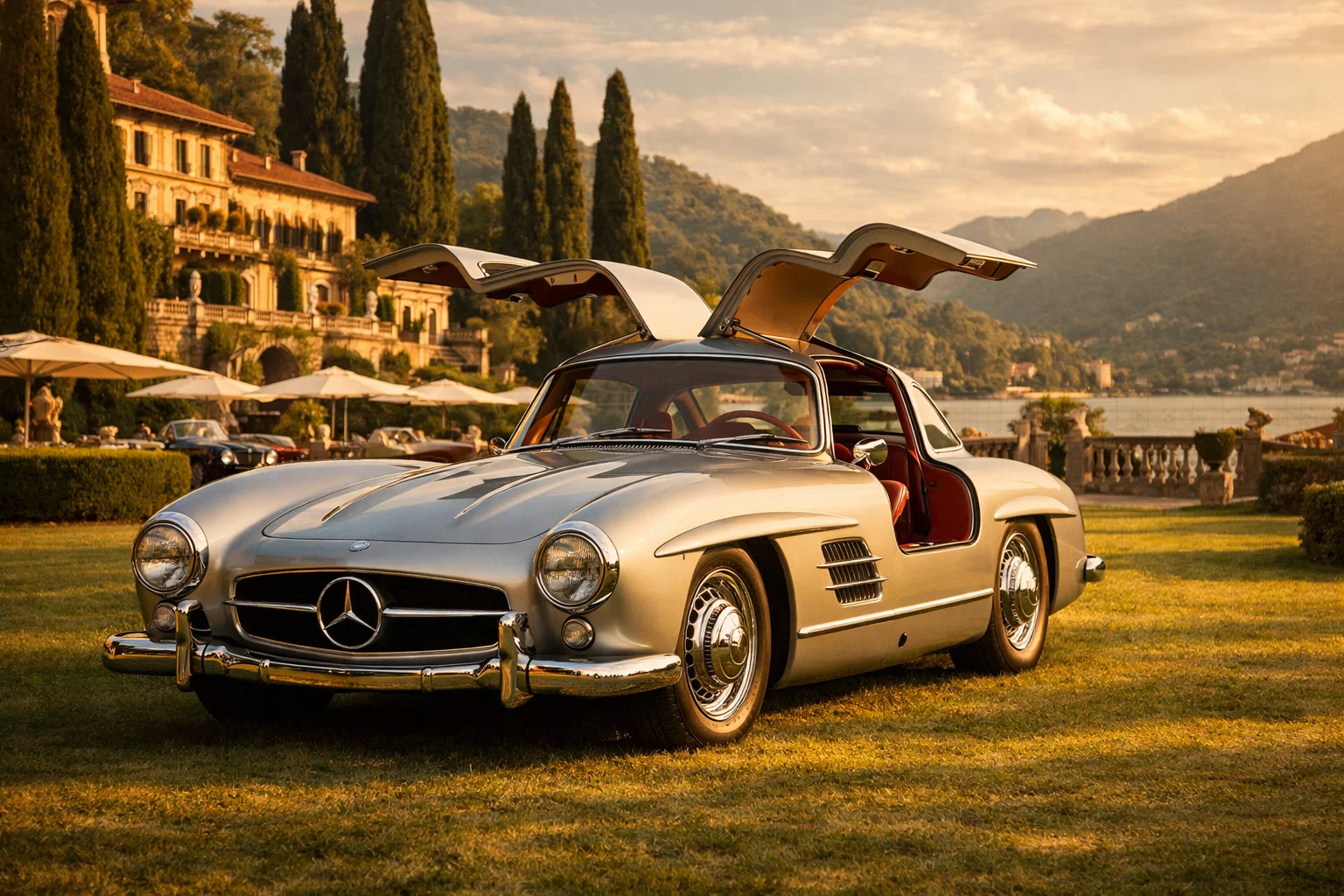
The doors open upward like gull wings. The inline-6 cuts through the air. You are looking at a 1955 Mercedes 300SL Gullwing, one of the most iconic cars ever built. Its story begins on a racetrack and ends at €1.5 million auctions.
From racetrack to showroom
The 300SL was not born for the street. In 1952 Mercedes wanted to return to racing after the war. They built the W194, a competition prototype with aluminum tubular chassis and 3-liter M186 engine.
The W194 won Le Mans 1952, the Carrera Panamericana and the Bern GP. American importer Max Hoffman saw the commercial potential and pressured Mercedes to make a street version.
Key fact: Hoffman placed an order for 1,000 units in advance. Without his guarantee, the street 300SL would never have existed.
Why the doors open upward
The tubular chassis needed large side sills to maintain rigidity. This made it impossible to install conventional doors. The solution was to open upward, using roof hinges.
The famous "Gullwing" doors were not an aesthetic whim. They were a consequence of chassis engineering.
The first production direct injection engine
The 300SL was the first mass-production car with direct fuel injection. Bosch developed the mechanical system that allowed the M198 to produce 215 HP from a 3.0L inline-6.
| Specification | Value |
|---|---|
| Engine | M198 3.0L L6 direct injection |
| Power | 215 HP @ 5,800 rpm |
| Top speed | 260 km/h (1955 record) |
| 0-100 km/h | 8.8 seconds |
| Weight | 1,295 kg |
Did you know it was the fastest production car in the world in 1955? 260 km/h wasn't surpassed in production until the 70s.
Only 1,400 units built
Between 1954 and 1957 Mercedes built 1,400 Gullwings. Then came the 300SL Roadster (1,858 units) that replaced the gull doors with conventional ones.
- 1954: production start in Stuttgart
- 1955: 867 units (peak production year)
- 1956: 311 units
- 1957: last Gullwing year (76 units)
Key fact: approximately 1,100 Gullwings survive today. Each is catalogued and monitored.
What price today
The 300SL Gullwing is one of the most appreciated classics in the world. Auction prices in 2024-2025 range from €1.2 to €1.8 million depending on condition and provenance.
| Condition | 2024 price | 5-year appreciation |
|---|---|---|
| Concours (level 1) | €1,500,000 - €1,800,000 | +35% |
| Professional restoration | €1,100,000 - €1,400,000 | +30% |
| Project | €450,000 - €700,000 | +25% |
Restoring a 300SL today
A frame-off restoration of a Gullwing costs between €250,000 and €400,000. Average time is 18-24 months. Most expensive parts are the engine (€80,000) and original chrome.
The 300SL chrome was silver-plated before chrome. Only two specialized workshops in the world reproduce this today.
Frequently asked questions
Where was the Mercedes 300SL Gullwing built?
Built at the Stuttgart-Untertürkheim plant between 1954 and 1957. Bodies came from Sindelfingen.
How many Gullwings remain today?
Of the 1,400 built, about 1,100 survive. Each is catalogued by the international 300SL Club registry.
Why is the 300SL so expensive?
It combines three factors: rarity (1,400 units), technological innovation (first direct injection) and cultural icon (Le Mans 1952, first Gullwing doors).
Can I see a 300SL Gullwing in Spain?
There are few examples in private collections. Museums like MNACTEC and foreign museum collections exhibit it occasionally.
The Mercedes 300SL Gullwing is more than a car. It's the answer to an engineering question that changed motoring. If you want to see classics of this caliber in person, visit our Gredos Garage museum. The collection rotates every season.