history
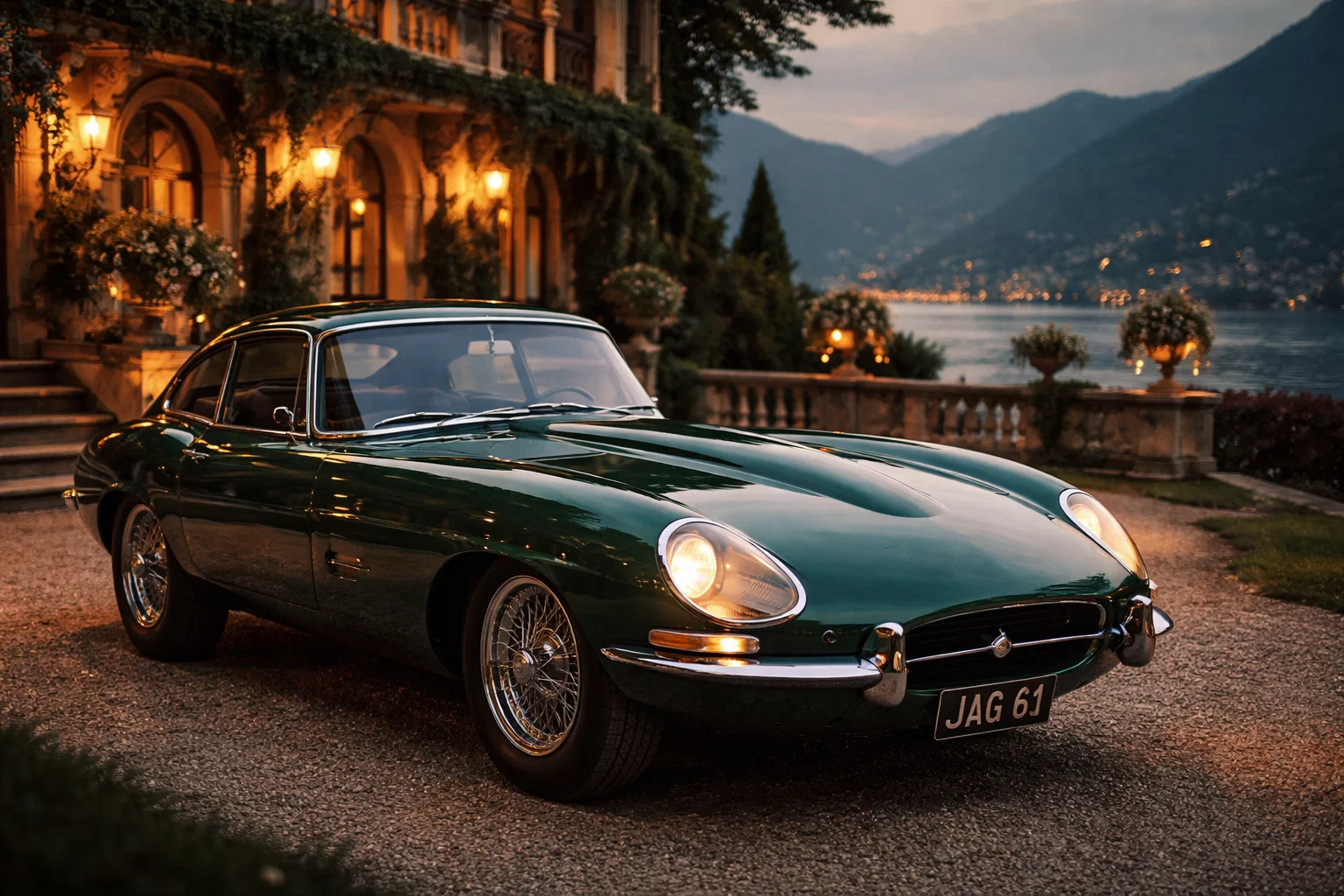
History of the Jaguar E-Type: the most beautiful car ever built
Discover the history of the Jaguar E-Type, the car Enzo Ferrari called the most beautiful ever made. From its 1961 Geneva debut to today million-euro auctions.
10 min read
The history of the Jaguar E-Type begins in March 1961. At the Geneva Motor Show, Jaguar unveiled a body that left everyone speechless. Enzo Ferrari saw it and called it "the most beautiful car ever made". A journalist did not say that. The man from Maranello did.
It cost 2,097 pounds in 1961. Half the price of a Ferrari 250 GT. It reached a real 240 km/h. It used a 3.8-litre XK engine with 265 HP. That was not a car. It was a revolution wrapped in aluminium. Today a Series 1 roadster in good condition exceeds 180,000 euros at auction. Competition-provenance examples approach one million.
This article reviews the 14 years of Jaguar E-Type production. Series, engines, current prices, facts, and why it remains the aesthetic benchmark of classic motoring.
Table of contents
- The origin: from D-Type to E-Type
- The three E-Type series (1961-1974)
- Engines, performance and real figures
- Current prices and auction records
- Restoring an E-Type: what to check
- Frequently asked questions
The origin: from D-Type to E-Type
Malcolm Sayer designed the E-Type. He was an aerodynamics engineer, not a stylist. He came from aviation. His method was pure mathematics. The E-Type curves are trigonometric functions drawn on graph paper.
Before the E-Type came the Jaguar D-Type. It won Le Mans in 1955, 1956 and 1957. Sayer applied all that D-Type aerodynamic experience to the E-Type. The drag coefficient hovered around 0.44. Very good for 1961.
The E1A prototype ran in 1957. It was a rolling laboratory. Then came the E2A in 1960, which raced at Le Mans with Briggs Cunningham. Did it win? No. But it proved the concept. In March 1961 the production E-Type debuted in Geneva painted Opalescent Gunmetal Grey.
- Designer: Malcolm Sayer, aerodynamicist
- Launch date: 15 March 1961, Geneva
- Chassis: steel monocoque with tubular front subframe
- Suspension: 4-wheel independent (revolutionary in 1961)
- UK launch price: 2,097 coupé, 2,037 roadster
Key fact: Sayer never had to modify the E-Type lines after presentation. The car was born perfect the first time. No other Jaguar design enjoyed that privilege.
Why the huge impact? Because in 1961 sports cars were crude. The E-Type offered 240 km/h, disc brakes on all four wheels and spaceship looks for 2,000 pounds. It sold over 70,000 units.
The three E-Type series (1961-1974)
The Jaguar E-Type lived through three official series over 14 years. Each marked a different aesthetic and technical era. Purists prefer Series 1. Collectors pay the same for a good Series 3 V12.
| Series | Years | Engine | Power | Units |
|---|---|---|---|---|
| Series 1 | 1961-1968 | 3.8 & 4.2 XK | 265 HP | 38,419 |
| Series 1.5 | 1967-1968 | 4.2 XK | 246 HP | approx. 5,700 |
| Series 2 | 1968-1971 | 4.2 XK | 246 HP | 18,809 |
| Series 3 | 1971-1974 | 5.3 V12 | 272 HP | 15,287 |
The Series 1 is purest. Glass-covered headlamps, thin indicators, chrome trim. The first 500 roadsters (up to chassis 850500) had flat floors and are most prized. They fetch double a later Series 1.
The Series 1.5 was the transition car. It lost covered headlamps due to US regulations. The Series 2 grew in grille, indicators and pedals. More safety, less elegance.
Expert tip: For investment, buy a flat-floor Series 1 3.8 roadster. For daily use, a Series 2 coupé 4.2 is more docile and reliable.
The Series 3 arrived in 1971 with the 5.3 V12. Roadster and 2+2 only. It abandoned purism but gained thrust. V12s are rising in value because nobody speculates with them, which paradoxically lifts prices.
Engines, performance and real figures
The XK engine in the E-Type is legend. Designed in the 1940s by William Heynes, Walter Hassan and Claude Baily during WWII air-raid watches. Used until 1992. Nearly 50 years of service. What modern engine lasts that?
The 3.8 XK delivered 265 HP at 5,500 rpm and 352 Nm at 4,000 rpm. Inline six, twin overhead cam, three SU HD8 carburettors. Iron block, aluminium head. Unmistakable sound.
| Version | 0-100 km/h | Top speed | Real consumption |
|---|---|---|---|
| Series 1 3.8 (1961) | 6.9 s | 241 km/h | 14-16 L/100 |
| Series 1 4.2 (1965) | 7.1 s | 240 km/h | 14-16 L/100 |
| Series 2 4.2 (1969) | 7.4 s | 235 km/h | 15-17 L/100 |
| Series 3 V12 (1972) | 6.4 s | 235 km/h | 20-25 L/100 |
The 240 km/h figure is real but nuanced. Jaguar loaned specially prepped cars to the press. A customer E-Type reached 225-230 km/h. Still, in 1961 nothing on sale came close.
- Gearbox: Moss 4-speed (until 1964), Jaguar 4-speed synchro (from 1965)
- Brakes: Dunlop discs on all 4 wheels (hard to find today)
- Steering: unassisted rack-and-pinion
- Weight: 1,234 kg Series 1 coupé
Trivia: Early E-Types used the Moss box inherited from the XK140. It was tough, with no synchro on first. Shifting in town was an art.
Current prices and auction records
The Jaguar E-Type market soared between 2012 and 2018. Then it stabilised. Today prices are predictable if you know series, condition and provenance. How much to enter? It depends on what you want to do with it.
| Version | Concours | Good condition | Project |
|---|---|---|---|
| S1 3.8 Roadster flat floor | 380,000 | 220,000 | 95,000 |
| S1 4.2 Roadster | 180,000 | 120,000 | 55,000 |
| S1 4.2 Coupé | 140,000 | 85,000 | 40,000 |
| S2 4.2 Roadster | 110,000 | 75,000 | 35,000 |
| S3 V12 Roadster | 135,000 | 85,000 | 38,000 |
The absolute record belongs to a Jaguar E-Type Lightweight 1963 sold by Bonhams in 2017 for 7.37 million dollars. Jaguar built only 12 original Lightweights. Aluminium body, 340 HP engine, competition-bound.
Auction record: E-Type Lightweight chassis S850664, sold for 7,370,000 USD at Bonhams Scottsdale 2017. The most expensive E-Type ever auctioned.
In 2014 Jaguar announced 6 "continuation" Lightweights to complete the original series. Sold at 1.2 million pounds each. Gone before built.
At the Gredos Garage museum we exhibit contemporaries of the E-Type. Visiting our La Adrada facility lets you compare Jaguar engineering with Ferrari, Aston Martin and Mercedes of the same era.
Restoring an E-Type: what to check before buying
A full E-Type restoration costs 80,000 to 150,000 euros done right. Done wrong, it costs double because you redo it. These are the critical points we review at our workshop before accepting a project.
- Front chassis: tubular, rusts from inside. Check welds and pitting.
- Floors and sills: monocoque Achilles heel. New panel set: 4,000.
- XK engine: compression, oil in coolant, blue smoke. Full rebuild 12,000-18,000.
- Numbering: matching numbers (engine, gearbox, chassis) boost value x1.5.
- Heritage Certificate: Jaguar issues official certificate for 50 pounds. Essential.
E-Type bodywork is complex. Hundreds of panels lead-loaded at seams. A bodyworker without original technique leaves permanent lumps under paint.
Workshop tip: Always request the Jaguar Heritage Certificate before buying. It confirms original engine, colour, delivery date and first dealer. Costs 50 pounds and saves headaches.
- Expensive parts: full bonnet 7,500, curved windscreen 1,800, IRS rear axles 2,500
- Average restoration time: 1,500-2,000 workshop hours
- Annual service: 800-1,500 in preventive maintenance
Frequently asked questions about the Jaguar E-Type
Why did Enzo Ferrari call it the most beautiful car?
He said it in 1961 seeing the E-Type in Geneva. Ferrari publicly acknowledged Sayer's design. An unusual gesture from him. The phrase repeated until it became the model's unofficial slogan.
Which E-Type is the most valuable?
The 1963 Lightweight E-Type, aluminium body and 340 HP. Only 12 original units. Record 7.37 million dollars in 2017.
Is a Series 2 or Series 3 worth buying?
Yes, if you want to drive it. They are more reliable, easier to handle and more affordable. A good Series 2 roadster sits around 75,000 euros. A V12 Series 3 has huge presence at 85,000.
How much fuel does a Jaguar E-Type use?
14 to 17 litres per 100 km on the six cylinders. The V12 Series 3 climbs to 20-25 litres. Not a daily driver. A Sunday car with guaranteed smile.
Can I register it as historic in Spain?
Yes. All E-Types are over 30 years old and qualify. Historic plates cut taxes, allow entry to low-emission zones with restrictions, and reduce MOT frequency to every 2-4 years.
Conclusion
The history of the Jaguar E-Type is the story of a car that changed everything in 1961. Revolutionary looks, absurd performance for the price and an XK engine that lasted half a century. It remains the aesthetic benchmark of classic motoring.
If British classics move you, visit us. At our Gredos Garage museum in La Adrada (Avila), one hour from Madrid, you can see models of the same era up close and understand why the E-Type marked a before and after. We are waiting for you.